
Mapping Grief:
A Guide to Accompanying Pain

"It is not that the pain disappears; it is that we learn to carry its weight without letting it prevent us from walking."
I. The Meaning of Pain: A Philosophical Perspective
Since ancient times, grief has been understood as a profoundly human experience — inevitable and transformative. Existential philosophy, from the Stoics like Epictetus to modern authors like Viktor Frankl, has pointed out that suffering is a constitutive part of life. It is not a failure of the emotional system, but a natural response to the loss of what was meaningful to us.
Rather than avoiding pain, the wise invite us to inhabit it with dignity, for within it lies the possibility of metamorphosis. Frankl (1946) expressed it clearly: "suffering ceases to be suffering at the moment it finds a meaning." Thus, grief is not something to be overcome, but something to be integrated into our biography. This text offers guidance and comfort to those going through grief — not from the urgency to heal quickly, but out of respect for emotional time and the singularity of the lost bond.
II. The Topography of Grief: A Psychoemotional Map
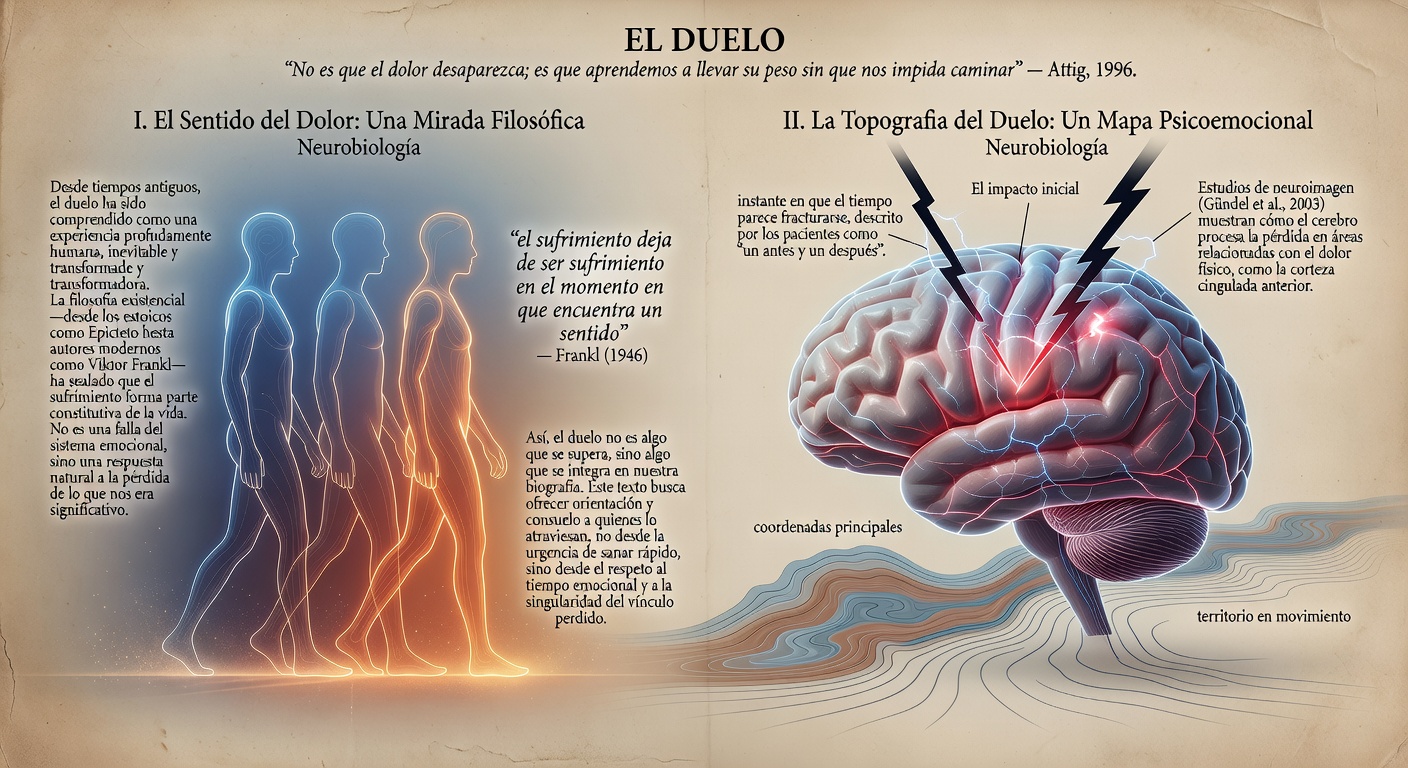
Grief is not a state, but a territory in motion whose main coordinates are:
- The initial impact: That instant when time seems to fracture, described by patients as "a before and an after." Neuroimaging studies (Gündel et al., 2003) show how the brain processes loss in areas related to physical pain, such as the anterior cingulate cortex.
- Psychic disorganization: A phase where prior cognitive schemas collapse. As Bowlby observed in his attachment theory, "losing whoever gave us emotional security is equivalent to losing our existential north."
- Reconstruction: An active (not automatic) process of redefining the relationship with what was lost and with oneself. Here emerges what Tedeschi & Calhoun (2004) call post-traumatic growth: the possibility of reconfiguring meaning after loss.
III. The Forms of Grief: Beyond Death
Contemporary clinical practice recognizes at least five categories of loss that can trigger grieving processes:
- Relational losses: death, divorce, emotional estrangement.
- Identity losses: unemployment, retirement, bodily changes.
- Future losses: abandoned projects, infertility, unfulfilled dreams.
- Symbolic losses: beliefs, ideals, faith.
- Ambiguous losses: disappearances, dementia, socially unrecognized relationships.
Each type requires specific processing strategies. For example, losses involving the future respond better to narrative therapies (White & Epston, 1990), while relational losses often require work with symbolic or transitional objects (Worden, 2008).
We must also consider how children experience grief: while they may not always grasp the permanence of loss, they intensely perceive the absence and the emotional transformation of the adults around them. In these cases, accompaniment should be clear, honest and calibrated to their capacity for symbolization.
Neurobiology of Grief
Grief is not merely an emotion: it involves the activation of attachment circuits, memory, social pain and adaptation. The brain does not "forget" the bond; it slowly learns to reorganize it.
Absence is experienced as a rupture of the expected bond
The brain continues to anticipate the other's presence. That is why loss is not processed immediately as a fact, but as a disorganization of the relationship.
Separation can feel physically real
Emotional suffering and bodily perception are deeply intertwined in the experience of grief.
Amygdala and affective hypervigilance
Loss increases sensitivity to signals, memories and stimuli that reactivate pain.
Hippocampus, evocation and searching for the absent
Memories arise powerfully because the brain is trying to update a reality that has changed.
Prefrontal cortex and processing
With time and accompaniment, the capacity to name and hold pain without being overwhelmed grows.
Neuroplasticity and new integration
It is not about erasing the one who was lost, but about building a new inner relationship with that bond.
IV. The Pillars of Transformation
The alchemical metaphor of "turning lead into gold" finds its scientific correlate in three essential pillars:
a) Symbolic processing
- Use of contemporary rituals: writing letters, creating digital memorials, planting a tree.
- Integration of alternative narratives: it is not about denying what was lost, but about asking: what does this loss leave behind?
b) Professional accompaniment
- Complex grief therapies (Shear, 2015)
- Somatic techniques for frozen grief (van der Kolk, 2014)
- Group accompaniment for sharing experiences in a validating framework.
c) Non-chronological time
Grief does not follow a standard calendar. Parkes (1998) reminds us that it is not about "overcoming" within a certain period, but about integrating the experience into the fabric of life. For some it may take months, for others years. There is no objective measure of pain.
V. Clinical Certainties About Grief
- Grief is not an illness, but it can become a prolonged grief disorder if its natural course is interrupted (as recognized by the DSM-5-TR after 12 months).
- The grieving person needs to act, not only to feel. Action has therapeutic value: talking, creating, deciding, writing.
- The bond with what was lost is not eliminated — it is transformed. fMRI studies show that memories reorganize, rather than disappear, after well-processed grief.
VI. Grief as a Rite of Passage
Just as traditional societies accompanied these processes with structured rituals, our contemporary task is to provide symbolic and affective frameworks where pain finds its place and meaning.
The great paradox of well-processed grief is that, by allowing us to touch bottom, it reveals an unexpected capacity to be reborn. Like all rites of passage, it leaves a scar — but it also leaves meaning.
Bibliographic References
- Attig, T. (1996). How We Grieve: Relearning the World. Oxford University Press.
- Frankl, V. E. (1946). Man's Search for Meaning. Beacon Press.
- Gündel, H. et al. (2003). Neural correlates of grief-related imagery. The American Journal of Psychiatry.
- Bowlby, J. (1980). Loss: Sadness and Depression. Basic Books.
- Tedeschi, R. G., & Calhoun, L. G. (2004). Posttraumatic growth.
- Worden, J. W. (2008). Grief Counseling and Grief Therapy.
Crisis Help
If you feel emotionally overwhelmed:
-
USA — Crisis Line988
-
UK — Samaritans116 123
-
Australia — Lifeline13 11 14
- International Chat (Befrienders)
Deep Reads
- Frankl, V. E. - Man's Search for Meaning.
- Neimeyer, R. A. - Lessons of Loss.
- Didion, J. - The Year of Magical Thinking.
- Kübler-Ross, E. - On Grief and Grieving.
- Lewis, C. S. - A Grief Observed.
Keep reading
Explore other topics linked to emotional well-being and inner transformation.